Bonds
Bond Terminology
Bond Indenture
- A statement of the terms of a bond as well as the amounts and dates of all payments to be made
Maturity Date
- The final repayment date of a bond
Term
- The time remaining until the final repayment date of a bond
Face Value
- AKA par value or principal amount
- Notional amount used to compute interest payments
Coupons
- The promised interest payments of a bond
- Paid periodically until the maturity date of the bond
Coupon Rate
- Set by the issuer and stated on the bond certificate
- By convention, expressed as an APR, so the amount of each coupon payment, CPN, is
Zero-Coupon Bonds
Only two cash flows
- The bond’s market price at the time of purchase
- The bond’s face value at maturity
Treasury bills are zero-coupon government bonds with maturity of up to one year
Risk-Free Interest Rates
A default-free zero-coupon bond that matures on date
- Law of One Price guarantees that the risk-free interest rate equals the yield to maturity on such a bond
- Refer to the YTM of such bond as risk-free interest rate
Spot Interest Rates
Default-free, zero-coupon yields
Coupon Bonds
- Pay face value at maturity
- Also make regular coupon interest payments
Return on a coupon bond comes from: - Any difference between the purchase price and the face value
- Periodic coupon payments
YTM of a Coupon Bond
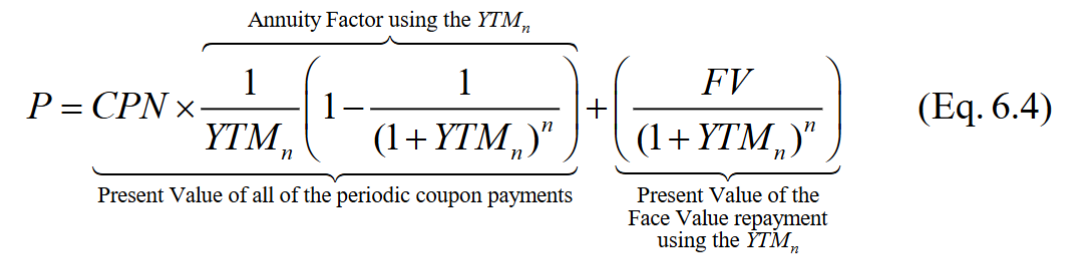
- The coupon payments represent an annuity, so the yield to maturity is the interest rate
that equates the bond’s price, , to the present value of an annuity of coupons plus the present value of the bond’s face value, FV:
Why Bond Prices Change
- Zero-coupon bonds always trade for a discount
- Coupon bonds may trade at a discount or at a premium
- Most issuers of coupon bonds choose a coupon rate so that the bonds will initially trade at, or very close to, par
- After the issue date, the market price of a bond changes over time
Interest Rate Changes and Bond Prices
- If a bond sells at par, the only return investors will earn is from the coupons that the bond pays
- The bond’s coupon rate will exactly equal its yield to maturity
- As interest rates in the economy fluctuate, the yields that investors demand will also change
- Longer term bonds are more sensitive to interest rate changes
- More risky
- Bond with smaller coupon payments is more sensitive to interest rate changes
- More risky
Key Terms
Premium:
- A price at which coupon bonds trade that is greater than their face value
Discount: - A price at which coupon bonds trade that is lower than their face value
Par: - A price at which coupon bonds trade that is equal to their face value
Determining the Discount or Premium of a Coupon Bond
- When the coupon rate of the bond is higher than its YTM, it trades at a premium
- When its coupon rate equals its YTM, it trades at par
- When its coupon rate is lower than its YTM, it trades at a discount
Corporate Bonds
Credit Risk
- The risk of default by the issuer of any bond that is not default free
- Indication that the bond’s cash flows are not known with certainty
- Corporations with higher default risk will need to pay higher coupons to attract buyers to their bonds
Corporate Bond Yields
- Yield to maturity of a defaultable bond is not equal to the expected return of investing in the bond
- A higher yield to maturity does not necessarily imply that a bond’s expected return is higher
Bond Ratings
Several companies rate the creditworthiness of bonds
- Investment-grade bonds
- Speculative bonds
- Junk bonds
- High-yield bonds
- The rating depends on
- The risk of bankruptcy
- Bondholders’ claim to assets in the event of bankruptcy
Corporate and Provincial Yield Curves
The credit spread is the difference between the various bonds and the Government of Canada
To provide a higher YTM, the purchase price for the debt must be lower