Link Layer
Datagram transferred by different link protocols over different links
- Each link protocol provides different services
- Trip from Princeton to Lausanne
- Car: Princeton to JFK
- Plane: JFK to Geneva
- Train: Geneva to Lausanne
- tourist = datagram
- transport segment = communication link
- transportation mode = link layer protocol
- travel agent = routing algorithm
Link Layer Services
Framing, Link Access:
- Encapsulate datagram into frame, adding header, trailer
- Channel access if shared medium
- MAC addresses used in frame headers to identify source, destination
Reliable delivery between adjacent nodes:
Flow Control: - Pacing between adjacent sending and receiving nodes
Error Detection: - Errors caused by signal attenuation, noise
- Receiver detects presence of errors:
- Signals sender for retransmission or dops frame
Error Correction:
- Signals sender for retransmission or dops frame
- Receiver identifies and corrects bit errors without resorting to retransmission
Half-duplex and full-duplex - With half duplex, nodes at both ends of link can transmit, but not at same time
Where is the link layer implemented
- In each and every host
- link layer implemented in adaptor or on a chip
- Ethernet card, 802.1.1 card
- Implements link, physical layer
- Attaches into host’s machine
- Combination of hardware, software, firmware
Adaptors Communicating
Sending Side:
- Encapsulates datagram in frame
- Adds error checking bits, rtd, flow control, etc.
Receiving Side: - Looks for errors, rdt, flow control, etc.
- Extracts datagram, passes to upper layer at receiving side
Error Detection
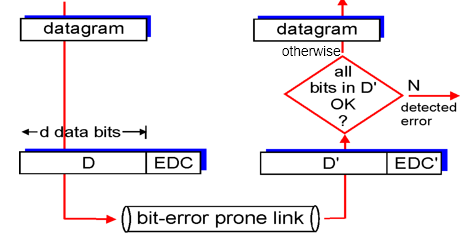
EDC = Error Detection and Correction bits (redundancy)
D = Data protected by error checking, may include header fields
- Error detection not 100% reliable
- Protocol may miss some errors, but rarely
- Larger EDC field yields better detection and correction
Parity Checking
Single bit parity:
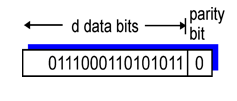
- Detect single bit errors
Two-dimensional bit parity:
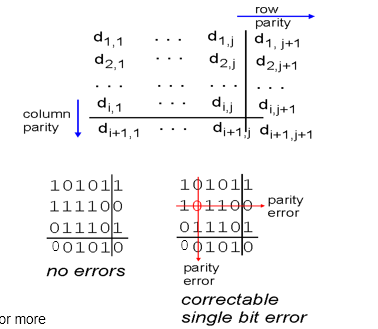
- Detect and correct single bit errors
Internet Checksum
Goal: detect “errors” in transmitted packet
- Used in transport layer only
Cyclic Redundancy Check
- More powerful error-detection coding
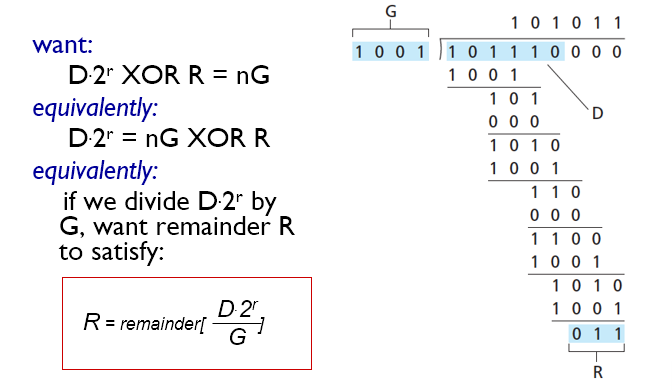
- View data bits, D, as a binary number
- Choose r+1 bit pattern, G
- Goal: choose r CRC bits, R, such that
- <D,R> exactly divisible by G (modulo 2)
- Receiver knows G, divides <D,R> by G. If non-zero remainder: ERROR DETECTED!
- Can detect all burst errors less that r+1 bits
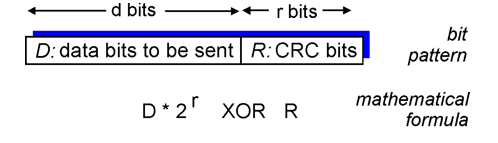
Example
Multiple Access Protocols
Single shared broadcast channel
- Collision if node receives two or more signals at the same time
- Determine how nodes share channel
- Communication about channel sharing must use channel itself
Two types of links:
- Point-to-point:
- PPP for dial-up access
- Point-to-point link between Ethernet switch, host
- Broadcast (shared wire or medium)
- Old-fashioned Ethernet
- Upstream HFC
- 802.1 1 wireless LAN
Random Access Protocols
- When node has packet to send
- Transmit at full channel data rate R
- No prior coordination among nodes
- Two or more transmitting nodes → Collision
- random access MAC protocol specifies:
- How to detect collisions
- How to recover from collisions
Slotted ALOHA
Assumptions
- All frames same size
- Time divided into equal size slots
- Time to transmit 1 frame
- Nodes start to transmit only slot beginning
- Nodes are synchronized
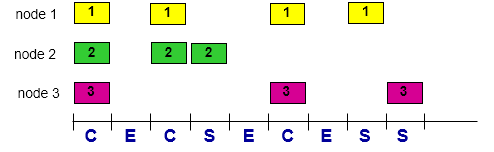
- If 2 or more nodes transmit in slot, all nodes detect collision
Operations
- When node obtains fresh frame, transmits in next slot
- if no collision:
- Node can send new frame in next slot
- if collision:
- Node retransmits frame in each subsequent slot with probability p until success
- Node retransmits frame in each subsequent slot with probability p until success
- if no collision:
Pros
- Single active node can continuously transmit at full rate of channel
- Highly decentralized: only slots in nodes need to be in sync
- Simple
Cons
- Collisions, wasting slots
- idle slots
- Nodes may be able to detect collision in less than time to transmit packet
- Clock synchronization
Efficiency
At best, channel used for useful transmission 37% of time
Pure ALOHA
Simpler, no synchronization
- When frame first arrives
- Transmit immediately
- Collision probability increases
- frame sent at
collides with other frames sent in
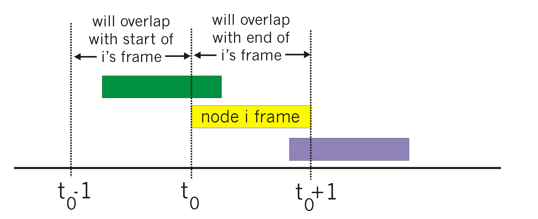
- frame sent at
Efficiency
Efficiency goes to 1
- as
goes to 0 - as
goes to
Better performance than ALOHA - Simple
- Cheap
- Decentralized
Taking turns MAC protocols
- Polling
- Master and slave nodes
- Token passing
- control token passed from one node to next
MAC addresses and ARP
32-bit IP address:
- network-layer address for interface
- used for network layer forwarding
- Not portable (postal code)
MAC Address:
Used locally to get frame from one interface to another physically-connected interface
- 48-bit MAC address burned in NIC ROM, also sometimes software settable
- e.g. 1A-2F-BB-76-09-AD
- hexadecimal, each numeral is 4 bits
- Portable (SSN)
ARP (Address resolution protocol)
Each IP node on LAN has table
- IP/MAC address mappings for some LAN nodes
- <IP address; MAC address; TTL>
- TTL (Time to Live):
- Time after which address mapping will be forgotten
- Typically 20 min
Switch
Link-layer device:
- store, forward Ethernet frames
- examine incoming frame’s MAC address, selectively forward frame to one-or-more outgoing links when frame is to be forwarded on segment
- Uses CSMA/CD to access segment
Transparent:
- Uses CSMA/CD to access segment
- Hosts are unaware of presence of switches
Plug-and-play, self-learning: - Switches do not need to be configured
Switch forwarding table
Each switch has a switch table with entries:
- (MAC address of host, interface to reach host, time stamp)
Self-learning
- Switch learns which hosts can be reached through which interfaces
- When frame received, switch learns location of sender: incoming LAN segment
- Records sender/location pair in switch table
If location unknown, flood
- Forward on all interfaces except arriving interface
Switches VS. Routers
Both are store-and-forward:
- Routers: network-layer devices
- Switches: link-layer devices
Both have forwarding tables: - Routers: Compute tables using routing algorithms, IP addresses
- Switches: Learn forwarding table using flooding, learning, MAC addresses