Control Plane
Routing: Determine route taken by packets from source to destination
- per-router control
- logically centralized control
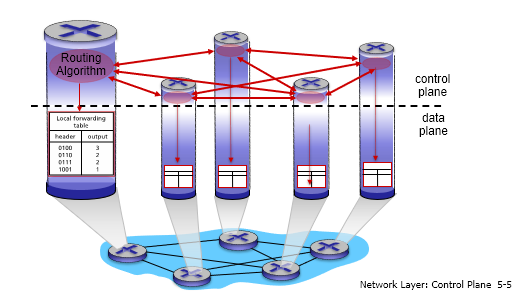
Per-router Control Plane
Individual routing algorithm components in each and every router interact with each other in control plane to compute forwarding tables
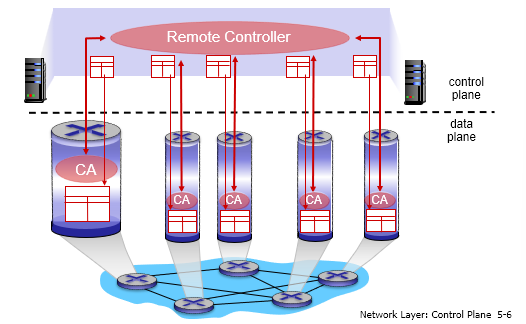
Logically Centralized Control Plane
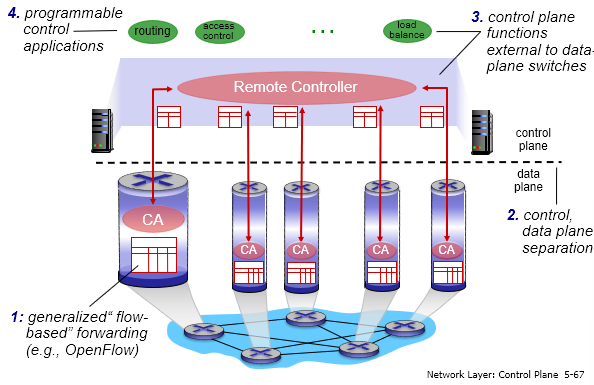
A distinct controller interacts with local control agents in routers to compute forwarding tables
Routing Protocols
Goal
Determine “good” paths from sending hosts to receiving hosts through network of routers
- good: least cost, fastest, least congested
Classification
Global VS decentralized information
Global:
- All routers have complete topology, link cost info
- link state algorithm
Decentralized: - Router knows physically-connected neighbors, link costs to neighbors, link costs to neighbors
- Iterative process of computation, exchange of info with neighbors
- distance vector algorithms
Static VS dynamic
Static:
- Routes change slowly over time
Dynamic: - Routes change more quickly
- Periodic update
- In response to link cost changes
Link State
Dijkstra’s Algorithm
- Net topology, link costs known to all nodes
- Accomplished via “link state broadcast”
- All nodes have same info
- Computes least cost paths from one node to all other nodes
- Iterative
- after k iterations know least cost path to k destinations
Complexity: n nodes
- after k iterations know least cost path to k destinations
- Each iteration: need to check all nodes, w, not in N
- n(n+1)/2 comparisons
possible
Distance Vector
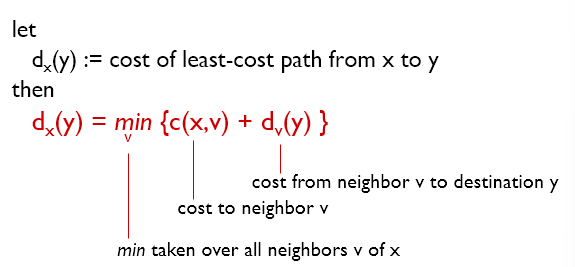
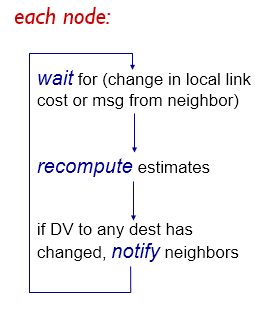
Node x only knows cost to each neighbor v
- From time to time, each node sends its own distance vector estimate to neighbors
Bellman-Ford Algorithm (DP)
Intra-AS Routing in the Internet: OSPF
Making routing scalable
Scale: with billions of destinations
- can’t store all destinations in routing tables
- routing table exchange would swamp links!
Administrative autonomy: - internet = network of networks
- each net5work admin may want to control routing in its own network
Intra-AS Routing
AKA interior gateway protocol (IGP)
- Routing among hosts, routers in same AS
- All routers in AS must run same intra-domain protocol
- Routers in different AS can run different intra-domain routing protocol
- Gateway router: at “edge” of its own AS, has links to routers in other AS’es
Most common intra-AS routing protocols: - RIP: Routing Information Protocol
- OSPF: Open Shortedst Path First
- IGRP: Interior Gateway Routing Protocol
Inter-AS Routing
- Routing among AS’es
- Gateways perform inter-domain routing
- as well as intra-domain routing
Tasks
- Learn which destinations are reachable through other AS
- Propagate this reachability info to all routers in AS
Interconnected AS’es
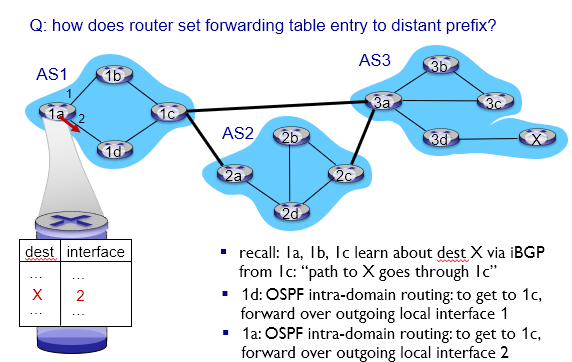
- Forwarding table configured by both intra-AS and inter-AS routing algorithms
- Intra-AS routing determine entries for destinations within AS
- inter-AS and intra-AS determine entries for external destinations
OSPF
Open Shortest Path First
- “Open”: publicly available
- Uses link-state algorithm
- Link state packet dissemination
- Topology map at each node
- Uses Dijkstra’s algorithm
- Router floods OSPF link-state advertisements to all other routers in entire AS
- Carried in OSPF messages directly over IP
- IS-IS routing protocol: nearly identical to OSPF
Advanced Features
- Security: all OSPF messages authenticated
- Multiple same-cost paths allowed
- For each link, multiple cost metrics for different types of service
- satellite link cost low for best effort ToS, high for real-time ToS
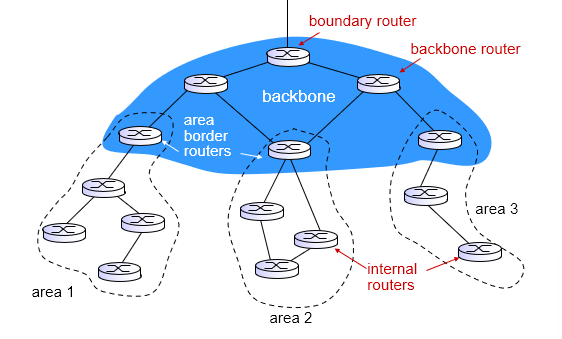
Hierarchical OSPF
- Two-level hierarchy: local area, backbone
- Link-state advertisements only in area
- Each nodes has detailed area topology; only know shortest paths to nets in other areas
- Area border routers: summarize distances to nets in own area, advertise to other Area Border routers
- Backbone routers: run OSPF routing limited to backbone
- Boundary routers: connect to other AS’es
BGP
Border Gateway Protocol
BGP provides each AS a means to:
- eBGP: obtain subnet reachability information from neighboring AS’es
- iBGP: propagate reachability to all AS-internal routers
- determine good routes to other networks based on reachability information and policy
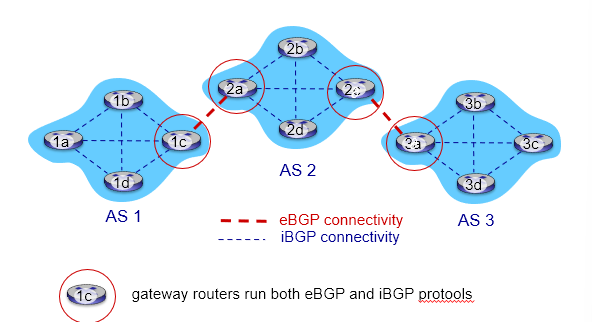
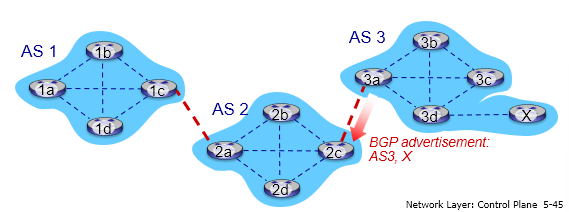
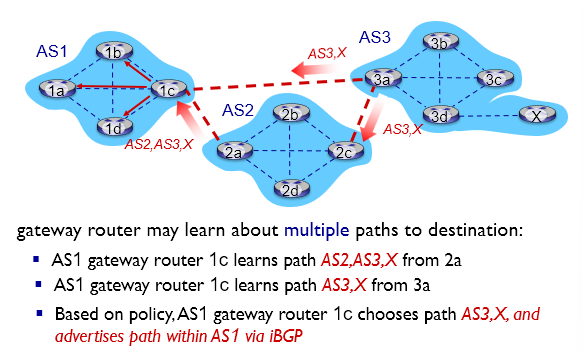
BGP Session: Two BGP routers exchange BGP messages over semi-permanent TCP connection - Advertising paths to different destination network prefixes
When AS3 gateway router 3a advertises path AS3,X to AS2 gateway router 2c:
- AS3 promises to AS2 it will forward datagrams towards X
Path Attributes and BGP Routes
Advertised prefix includes BGP attributes
- prefix + attributes = “route”
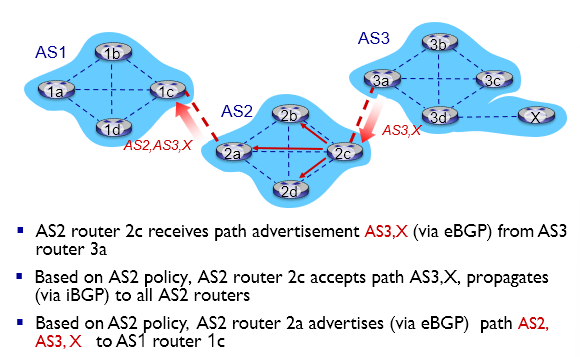
Two important attributes: - AS-PATH: list of AS’es through which prefix advertisement has passed
- NEXT-HOP: indicates specific internal-AS router to next-hop AS
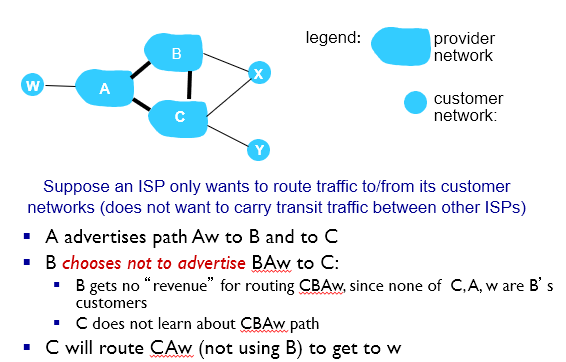
Policy-based routing: - Gateway receiving route advertisement uses import policy to accept/decline path
- AS policy also determines whether to advertise path to other neighboring AS’es
Multiple paths
BGP Messages
BSP messages exchanged between peers over TCP connection
- OPEN: opens TCP connection to remote BGP peer and authenticates sending BGP peer
- UPDATE: advertises new path
- KEEPALIVE: keeps connections alive in absence of UPDATES; also ACKs OPEN request
- NOTIFICATION: reports errors in previous msg; also used to close connection
BGP Route Selection
Router may learn about more than one route to destination AS, selects route based on:
- Local preference value attribute: policy decision
- Shortest AS-PATH
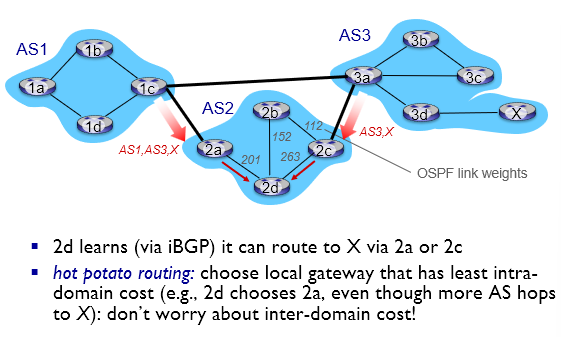
- closest NEXT-HOP router: hot potato routing
- additional criteria
Hot Potato Routing
Chooses local gateway that has least intra-domain cost
- Don’t worry about inter-domain cost
Achieving Policy via Advertisements
B only wants to route traffic to/from its customer networks
- Does not want to carry transit traffic between other ISPs
Why different Intra-AS, Inter-AS Routing?
Policy:
- Inter-AS: admin wants control over how its traffic is routed, who routes through its net
- Intra-AS: single admin, so no policy decisions needed
Scale: - Hierarchical routing saves table size, reduced update traffic
Performance: - Intra-AS: can focus on performance
- Inter-AS: policy can dominate over performance
Software Defined Networking (SDN)
Why a logically centralized control plane?
- Easier network management
- Avoid router misconfigurations, greater flexibility of traffic flows
- Table-based forwarding allows programming routers
- Centralized programming easier: compute tables centrally and distribute
- Distributed programming: more difficult
- Open implementation of control plane
Data Plane Switches
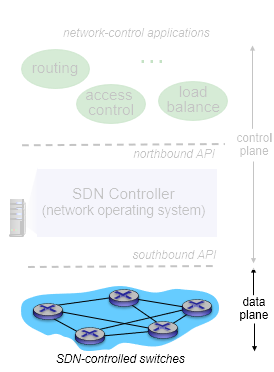
- Fast, simple, commodity switches implementing generalized data-plane forwarding in hardware
- Switch flow table computed, installed by controller
- API for table-based switch control
- Protocol for communicating with controller
SDN Controller
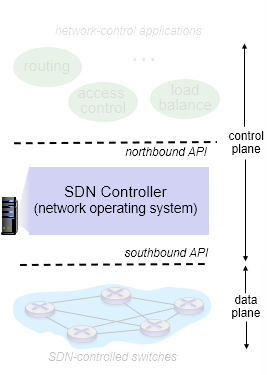
- Maintain networks state information
- Interacts with network control applications via northbound API
- Interacts with network switches via southbound API
- Implemented distributed system for performance, scalability, fault-tolerance, robustness
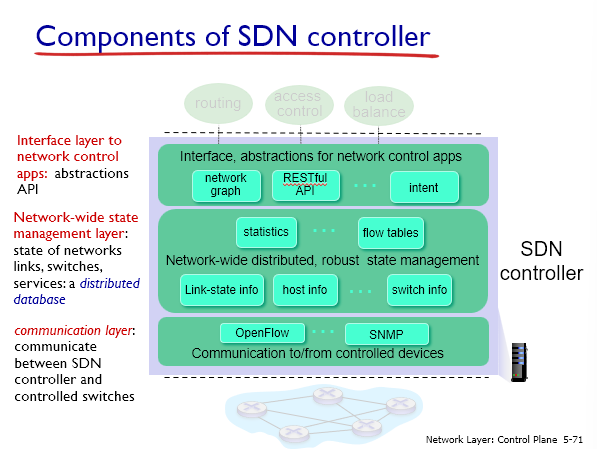
Network-control Apps
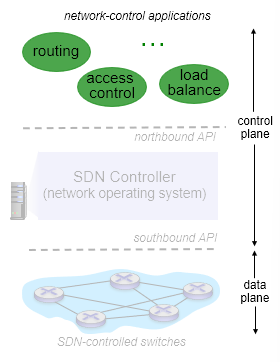
- Brains of control
- implement control functions using lower level services, API provided by SDN controller
- Unbundled: can be provided by third party